Your credit score dictates your mortgage interest rate, and even a minor 50-point change can cost or save you tens of thousands of dollars. Lenders group borrowers into credit tiers, applying risk-based fees that alter final interest rates. Moving from a FICO score of 680 to 730 can lower your interest rate by roughly 0.5% to 0.75%. Over a 30-year term, this rate drop cuts monthly payments significantly and saves substantial interest. Improving your credit score is one of the most effective ways to expand your homebuying budget.
When preparing to buy a home, most buyers spend months saving for a down payment and cleaning up their bank statements. While these steps are necessary, your credit score deserves equal attention. It is the main lever that controls the cost of your home loan.
Many first-time buyers believe that pre-approval is a simple binary process (you are either approved or denied). In reality, mortgage pricing is highly customized. Lenders use your credit history to determine your individual interest rate, creating a direct link between credit scores and monthly housing costs.
To see how interest rate fluctuations impact your personal budget in real time, you can input your numbers directly into our primary mortgage calculator.
How Credit Tiers Shape Mortgage Rates
Lenders set conventional mortgage pricing using Loan-Level Price Adjustments (LLPAs). LLPAs are risk-based fees defined by Fannie Mae and Freddie Mac. These adjustments evaluate two variables: your down payment size and your FICO credit score.
Borrowers with higher credit scores present less default risk, allowing them to secure lower interest rates. As your credit score drops, the risk fees increase, raising the base interest rate on your loan. Even small rate changes alter your purchasing limits, similar to the mathematical budget shifts outlined in our guide to the 1% interest rate rule.
To research federal fair lending rules and check consumer credit guidelines, consult the consumer education portal managed by the Federal Trade Commission (FTC), or read credit score guides published by myFICO.
The Financial Cost of a 50-Point Credit Swing
Let us look at a financial comparison. Consider two buyers purchasing a $400,000 home with a 10% down payment, resulting in a loan amount of $360,000. Here is how their credit scores impact their monthly payments and total interest over a standard 30-year fixed term:
Buyer A: FICO Score of 680
With a credit score in the fair-to-good range, Buyer A qualifies for an interest rate of 7.00%. Their monthly Principal & Interest payment is $2,395. Over the life of the 30-year loan, their cumulative interest fees will total $502,238.
Buyer B: FICO Score of 730
By lifting their credit profile into the very good tier, Buyer B qualifies for an interest rate of 6.375%. Their monthly Principal & Interest payment is $2,246. Over the life of the 30-year loan, their cumulative interest fees will total $448,517.
The Financial Comparison: What is at Stake?
Lifting your credit score by 50 points results in a monthly payment savings of $149. Over the full 30-year term, Buyer B saves exactly $53,721 in interest. You can evaluate the detailed flow of these payments by reviewing a full amortization schedule.
Actionable Credit Optimization Steps
Lifting your FICO profile requires focusing on two main areas. First, lower your credit utilization by keeping card balances below 10% of their limits. Second, pull your official credit reports to check for errors. Disputing incorrect late payments or collection accounts can quickly resolve reporting mistakes and raise your score.
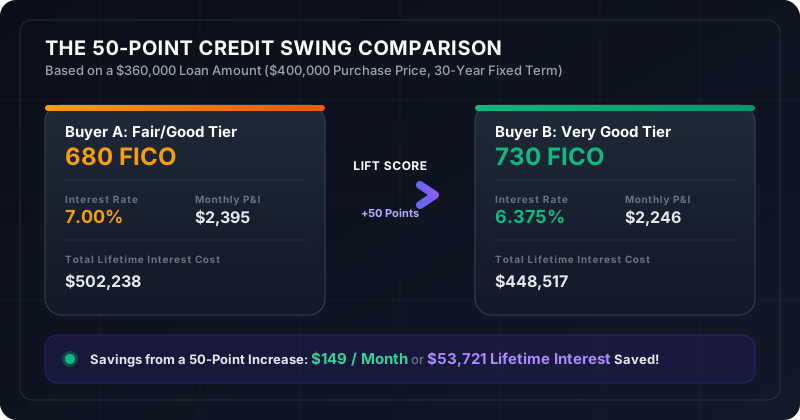
Figure 1: Improving your credit score is one of the most effective strategies to lower your total cost of homeownership.
Analyze Payments Over Different Interest Rates
Check how different interest rates change your monthly payments and long-term interest cost to map your true savings potential.