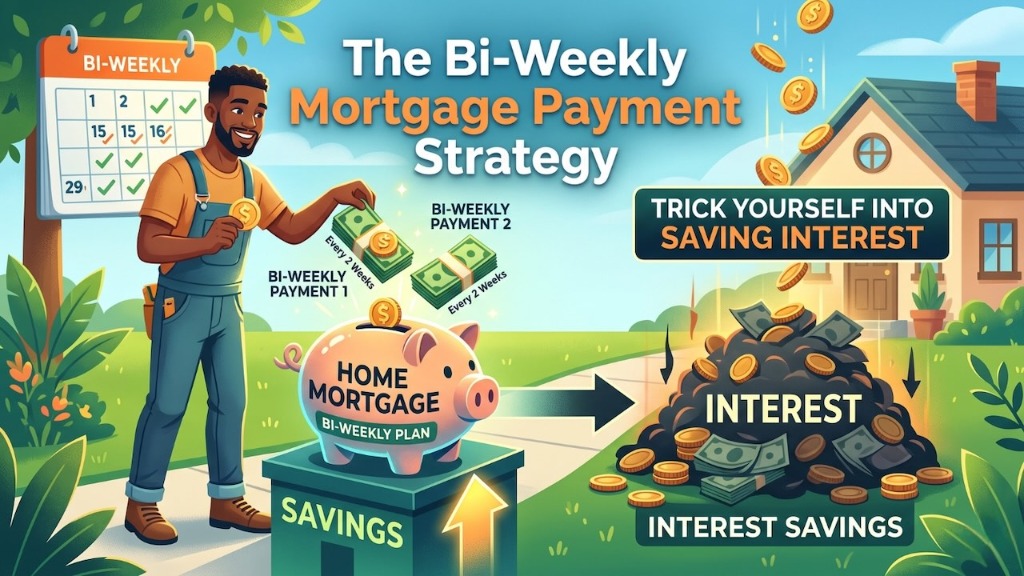
The bi-weekly mortgage strategy accelerates your amortization schedule by splitting your monthly principal and interest payment in half and paying it every two weeks. Because a calendar year has 52 weeks, you make 26 half-payments. This adds up to 13 full payments per year, translating to one extra monthly payment applied directly to your principal. This simple change shaves about 4 to 5 years off a standard 30-year mortgage and saves you over $100,000 in lifetime interest without feeling like a budget adjustment.
Most homeowners look for complex investment methods to grow their long-term wealth, neglecting the easiest financial asset right under their nose: their mortgage balance. Paying down a mortgage early offers a guaranteed rate of return equal to your loan interest rate, which is a powerful risk-free option.
While writing an extra check directly to your principal is a proven way to reduce debt, human behavior often gets in the way. That is why automated systems are so effective. The bi-weekly payment schedule tricks you into paying extra principal without changing your monthly lifestyle.
The Math Behind the Bi-Weekly Schedule
A standard mortgage payment schedule requires 12 payments a year. If your monthly principal and interest check is $2,528, you pay $30,336 over 12 months.
Under a bi-weekly strategy, you pay exactly half of that monthly payment, which is $1,264, every two weeks. Because there are 52 weeks in a year, you make 26 bi-weekly payments.
Multiply $1,264 by 26, and your annual outlay totals $32,864. This equals $2,528 more than the monthly schedule, which is exactly one extra monthly payment per year. By paying every two weeks, you make 13 full payments instead of 12, accelerating your equity build.
Case Study: Standard Monthly vs. Bi-Weekly
Let us evaluate the trade-offs on a $400,000 mortgage at an interest rate of 6.5% using a standard 30-year fixed term. To test custom parameters and rate variations yourself, you can run numbers through our primary mortgage calculator.
| Payment Strategy | Payment Amount | Total Annual Outlay | Payoff Timeline | Lifetime Interest Paid |
|---|---|---|---|---|
| Standard Monthly | $2,528.27 / mo | $30,339.24 | 30.0 Years | $510,190 |
| Bi-Weekly Strategy | $1,264.14 every 2 weeks | $32,867.64 | 25.3 Years | $408,311 |
| Total Savings | Equivalent to 1 Extra Pmt | +$2,528.40 / yr | Saves 4.7 Years | Saves $101,879 |
By shifting to bi-weekly payments, you reduce your payoff term from 30 years to 25.3 years. That is almost five years of mortgage checks eliminated. Plus, you save a staggering $101,879 in interest fees that would have gone to the bank. You can track this month-by-month principal drop using an interactive amortization schedule.
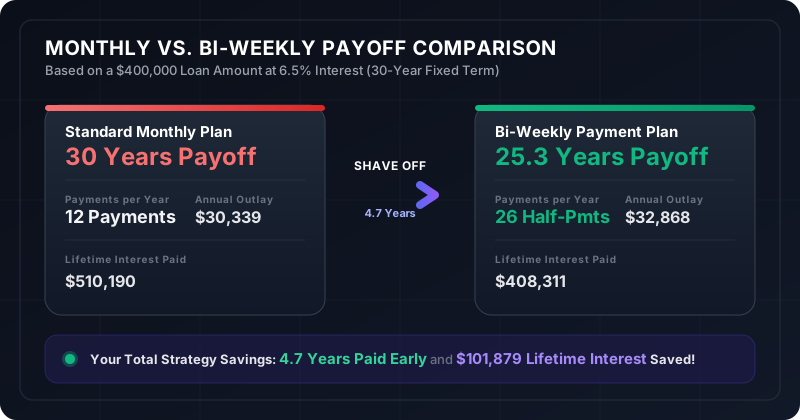
Figure 1: Bi-weekly payments trim your payoff timeline and save significant interest by accelerating principal reduction.
The Psychological Trick: Why It Feels Effortless
The core appeal of the bi-weekly schedule is that it aligns with standard pay schedules. If you are paid every two weeks (26 times a year), budgeting is simple. You match your mortgage draft directly with your paychecks.
For 10 months of the year, you receive two paychecks and make two half-payments, matching your standard monthly budget. In the remaining two months, you receive three paychecks. Because you have automated the drafts, the third paycheck makes a third half-payment automatically. You save interest without manual intervention.
How to Set Up the Strategy Safely
Before launching a bi-weekly payment schedule, you must confirm how your lender handles partial payments. According to guidelines set by the Consumer Financial Protection Bureau (CFPB), mortgage servicers do not have to apply partial payments to your balance immediately.
Instead, many lenders hold your first half-payment in a suspense account until the second half arrives. They then apply the full check to your account. This is normal, but it means you do not get daily interest savings benefits on the first half-payment. The real value is simply the automated extra payment at the end of the year.
Three Ways to Implement:
- Official Lender Program: Contact your loan servicer to enroll. Avoid paying third-party setup fees; many banks offer this setup for free.
- The Do-It-Yourself (DIY) Method: Replicate the math yourself by adding an extra 1/12th of your principal payment to your regular monthly payment. For a $2,528 payment, add $210 each month. This has the exact same financial impact.
- Annual Extra Payment: Write one extra full check to your principal balance each year, using a bonus or tax refund. Learn more about timing these prepayments in our guide to making extra payments.
Things to Avoid and Lender Rules
You must read the fine print before signing up for a servicer-led bi-weekly program. Some third-party billing agencies charge setup fees of $200 to $400, or transaction fees of $5 per draft. These expenses eat into your interest savings.
Additionally, make sure you do not have prepayment penalties on your loan. Prepayment penalties are rare on modern residential mortgages, but it is always smart to check your loan documentation or consult resources from the Federal Reserve.
If you have other high-interest debt, such as credit cards, it is wiser to pay those off first. Clearing double-digit credit card interest yields a much higher return than prepaying a 6.5% mortgage.
Calculate Your Payoff Savings
Use our prepayment calculator to see how adding extra payments or shifting to bi-weekly terms affects your payoff date and lifetime interest.